

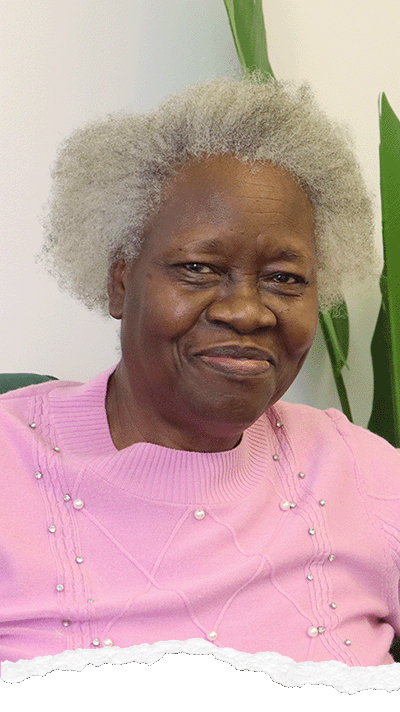
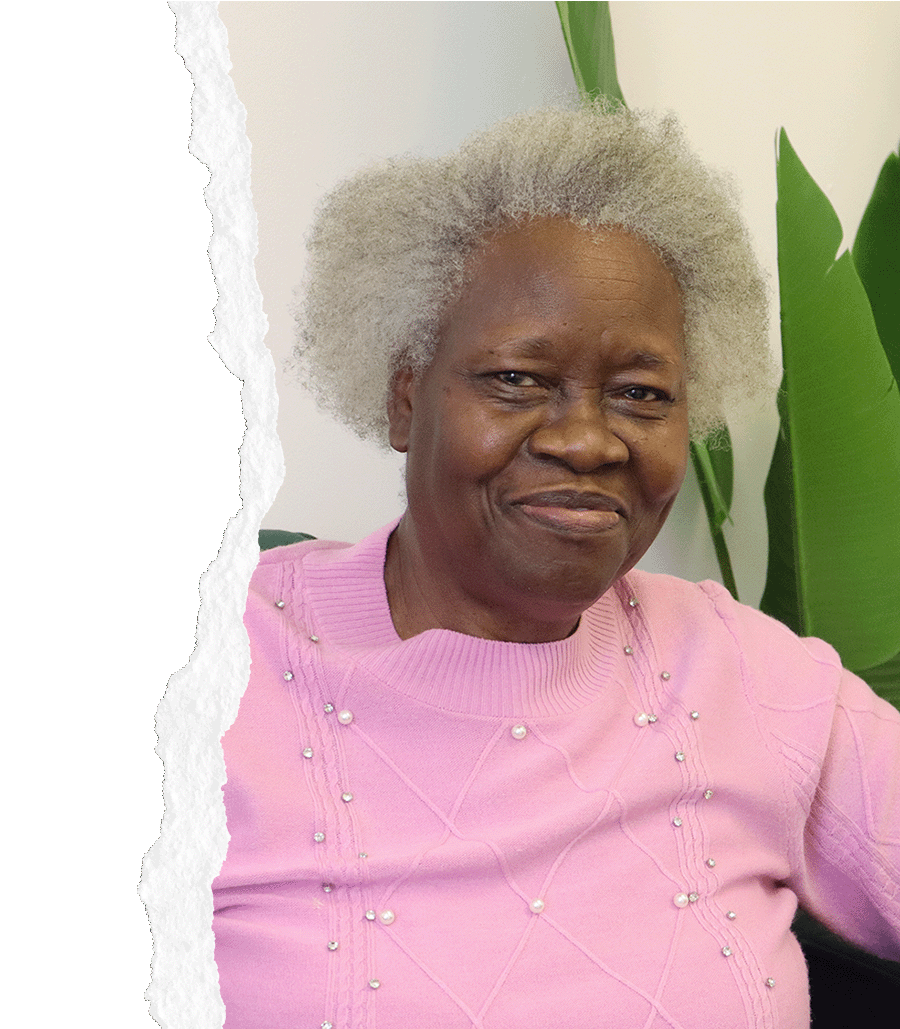
Melvita Johnson
“Ef fish deh a river bottom an tell yu seh alligator have gum boil, believe him”
Translation:
“If the fish in the river tells you that the alligator has gum boil, believe the fish”Explanation:
Listen to the voice of experience.
Place of Origin: Hanover, Jamaica
Arrival: 1963
A story of faith, family, and togetherness
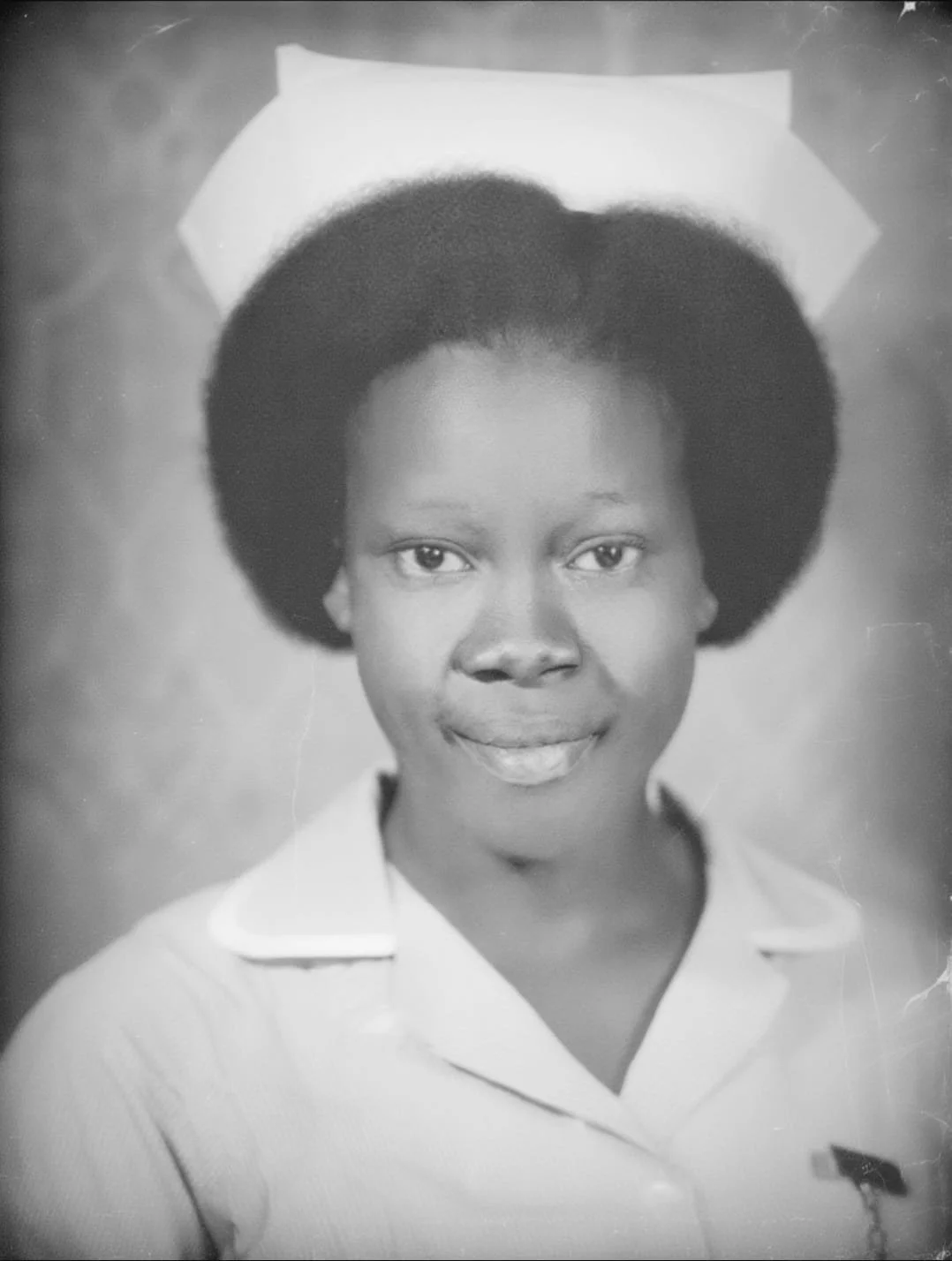
Born in Lucea, Jamaica and raised between family members before joining her mother in the UK in 1963, Melveta reflects on a childhood shaped by separation, resilience, and strong family bonds. She remembers the shock of arriving in cold, grey England, but found community through family, church, and work in nursing.
Known for her warmth and generosity, she carried on her mother’s tradition of big Sunday meals and became a quiet trendsetter in her community. Her story is one of faith, family, and creating a life rooted in love and togetherness.
Listen to Melvita's Oral Stories
Travelling to the UK
-
Interviewer: Can you remember much about the journey?
Melvita: Oh gosh. laughter Yeah, we were children that were cared for by the erm, stewardesses on the plane and there was a group of us, and we stopped in, I think it was Miami, somewhere and then we leave from there we had to change planes because then it was not the big jumbo jet that could fly straight on, so they had to change at, erm, they had to change at, I think it was Miami.
Interviewer: What's the weather like?
Melvita: Oh, yeah, when I got here, I was surprised. It wasn't the way I expected. And the clouds were hanging, it was pretty dark. It was freezing in the early morning when we landed.
Interviewer: What were your erm, what was it like when you left Jamaica, erm, and saying goodbye?
Melvita: You mean the sunshine? It was bright and beautiful. laughter And I was saying goodbye to my grandmother, my aunt and my cousins. Yes, and it was a little bit emotional.
Interviewer: Was there anything specific that you took with you from home to remember?
Melvita: Not really, I don't think so. I just had my clothes and a little suitcase. laughter
Interviewer: Share with me your journey from... share with me your journey, from Jamaica to the UK. Is this the first time you've been on an airplane? And how did that feel?
Melvita: Yes, it was the first time I've been on an airplane. Erm, I don't think I've thought about it, you know, how it felt or anything like that. As children, you just go along with anything, don't you? So.
Family
-
Interviewer: How did you meet your husband?
Melvita: Oh, how did I meet my husband? That's how you met, yes. When I was working in East Birmingham Hospital, the girls I worked with, they used to go out and they would drag me along with them. reluctantly some of the times, but I would go, just to be sociable, and I met my husband at a nightclub. I can't remember if it's the Locarno or one of the others. I can't remember. Anyway, I met my husband at a nightclub. We went out dancing. It was about six of us as girls. and we were dancing around with our handbags in the middle laughter because we usually put our handbags to keep them safe, where we are. And while we were there, this young man came and tapped me on my back and wanted to dance with me. I didn't really want to go and dance with him laughter, but the other girls, they said, oh, go on, you know. And so I went and that was where it all started.
Interviewer: And you've been married for how many years now?
Melvita: Help me Michelle.
Michelle: You were married in 1970 and he passed away in 2016.
Interviewer: And your husband's name.
Melvita: Desmond.
Interviewer: Tell me a little bit about Desmond.
Melvita: Oh, laughter he was a short dresser, a sweet talker. laughter He worked for British Rails. Yeah. About 40 years, he said. Wow.
Interviewer: Okay. And tell me about your children.
Melvita: Yeah, they were good children, and some people... complain about the behaviour of their children or the problems that they go through. I never had any problem with my children. I want to say thanks be to God. They were all brought up in the church, because me and my husband were the saved and we brought them up as uh, as us. So they knew boundaries, and things like that. So, they knew how to behave and they've done very well. laughter I can say they've all got their erm, training or erm, education. What's the word? Yeah, they all have a good education erm, and they've made well of it. My daughter here, Michelle, the youngest, she has been a erm social worker for years and then she's now in her own business. So I'm very, very proud of her.
Michelle: Thank you. laughter
Melvita: My daughter, Pamela, she is probably more the quiet one. laughter I don't know. She's more subtle and she's married and had children and I think that's took more of a space than working, so to speak. My son, he is a computer expert, should I say. laughter He does everything in computer. Anything that you can think of, you can do it.
Michelle: And he teaches.
Melvita: He teaches and he's now a consultant.
Work and Fashion Trends
-
Interviewer: Right, your first job?
Melvita: I was cleaning compact mirrors, the little compacts. Yeah, I used to have to clean, polish the mirrors and pack them. And erm, I only used to get 3 pounds something a week. laughter Three pounds of a week. Yeah.
Interviewer: Did you work in any of the factories at all?
Melvita: Oh yeah, after I left that place, I went to a car, erm, parts place and I used to work on this machine. We had to stamp on the metal to make big car parts, little small car parts and we used to have to stamp on them, to bend them into the shape and then pat them. And then from there I went to a er, bolts factory, you know bolts, door bolts, the little bolts. And I used to have to spray those. and then let them dry and then polish them and pack them. Those, oh yeah. The last one was a tailor factory, tailoring. I used to have to press the pleats open where they made, when the stitch, the stitchers stitch them, I used to have to press the pleats open.
Interviewer: By press because I know that people are going to be listening to your story. When you say press, for a Caribbean person, we understand what press means. But for the benefit of those that are listening, what does press mean?
Melvita: Ironing.
Interviewer: Okay laughter.
Michelle: I kind of explained where your... your dressmaking because she used to make dresses, make our dresses as well. And even things like the rah-rah skirts, I have to say that was something that my mum invented because we were the first to have rah-rah skirts that she made. laughter And then before you know it, we started seeing them everywhere. And the same with our hair bows, we used to have these with like leftover fabric, she would make a bow and we'd stick it in her hair with a hair grip, and then before you know it, everybody's wearing these bow clips. laughter I would say my mum's an inventor too. laughter Yeah.